
This person is a needle in a haystack. An almost impossible combination of structured thinker and visionary leader.
—Tony Fadell, Build [1]
Ready to start learning?
Use our finder to explore current offerings or learn more about a specific course
Product Management
Product Management is the function responsible for defining desirable, viable, feasible, and sustainable solutions that meet customer needs and supporting development across the product life cycle.
The role scales with the complexity of the Solution. For some solutions, the Product Management function may be carried out by a single Product Manager. For others, a team of Product Managers may be required.
Details
Successful solutions progress through the four distinct stages of the product life cycle: introduction, growth, maturity, and decline. Product Management guides each solution through these stages, ensuring that maximum business value is achieved over the life of the solution.
Regardless of whether a solution is consumed internally or sold externally, Product Management is essential to its success. This article describes Product Management’s multi-faceted role in SAFe and how it enables the continuous, sustained delivery of value.
Key Collaborations
Converting ideas into a steady stream of valuable products and services is a complex endeavor that requires ongoing coordination and communication across the organization. Product Management is integral to this process but does not have all the domain knowledge or capacity to execute it alone. Figure 1 illustrates the collaborative partnerships Product Management maintains to enable quick and efficient product development flow.
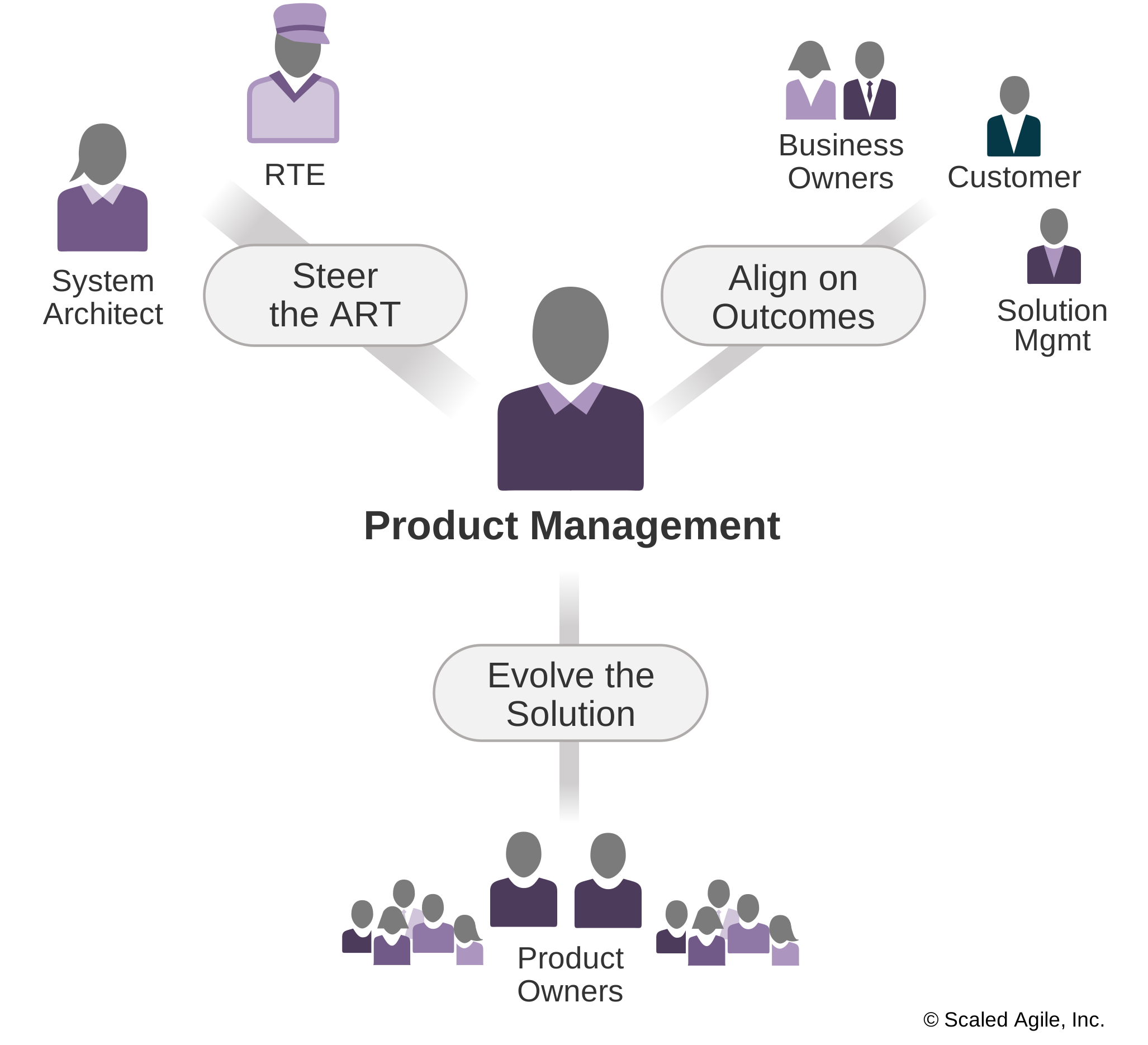
Each branch in the diagram represents a set of relationships that Product Management leverages to guide solutions effectively through the product life cycle. The nature of these relationships is described below.
- Align on outcomes – Product Management ensures that solutions deliver tangible business value. They collaborate directly with Customers, Business Owners, and, when appropriate, Solution Management to understand the market forces, desired economic outcomes, and broader solution vision influencing product strategy.
- Steer the ART – Product Management collaborates frequently with System Architects and the Release Train Engineer (RTE) to guide the ART toward successful delivery. Together they form an essential leadership triad that maintains constant synergy between product strategy and implementation.
- Evolve the solution – Ultimately, it is up to Agile Teams to execute the product strategy by developing, delivering, and continuously enhancing solutions. Product Management synchronizes frequently with the Product Owners of those teams, providing them with accurate business context and receiving feedback on the feasibility of implementation.
Responsibilities
Product Management’s responsibilities in SAFe fall into five main areas, as shown in Figure 2.
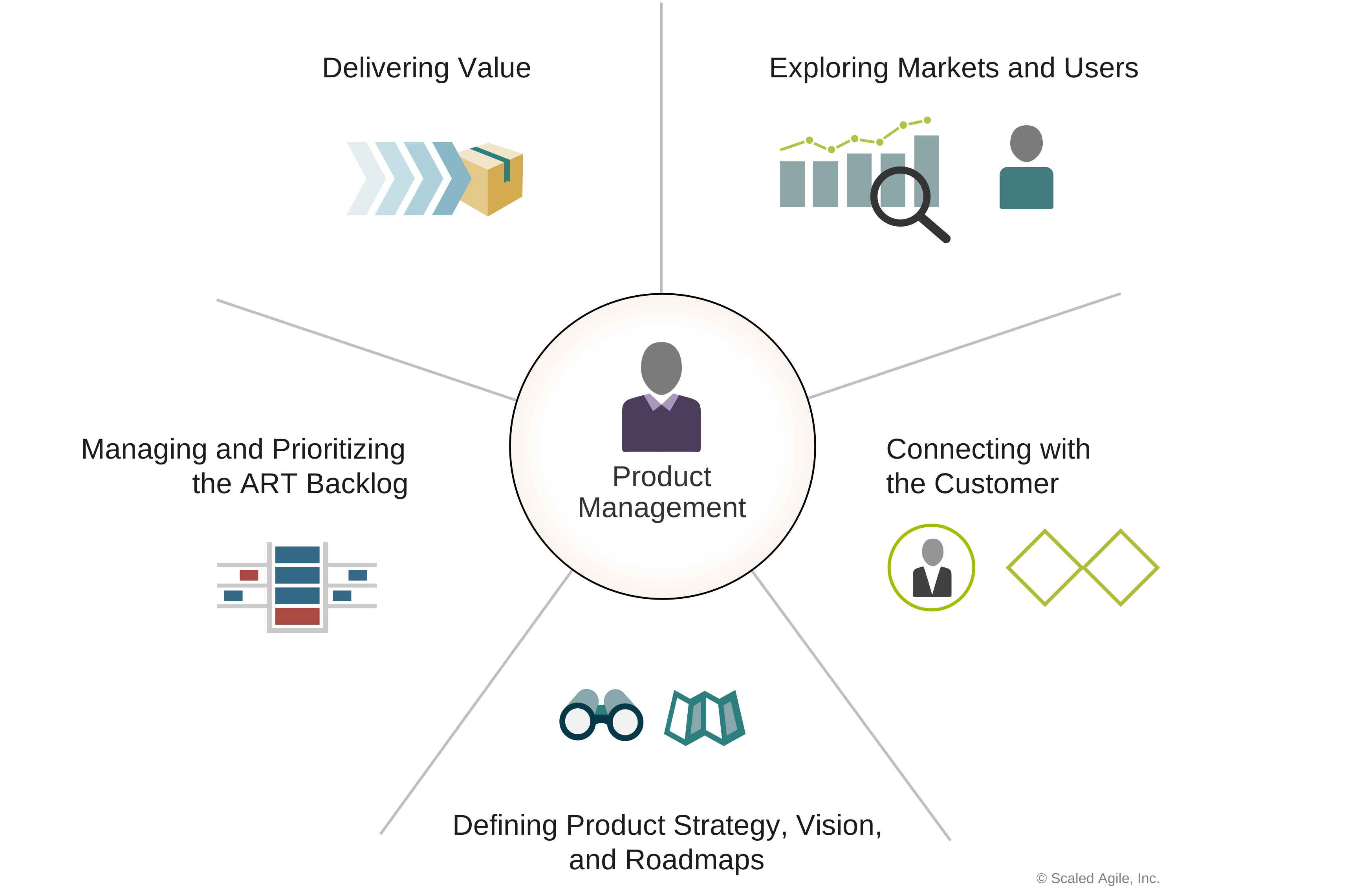
Each area of responsibility is described below, followed by additional guidance for ensuring that the Product Management function delivers maximum value to customers and the enterprise.
Exploring Markets and Users
Product Management continuously explores the Solution Context, gathering qualitative and quantitative insights about market dynamics and user preferences. These insights inform both business strategy and technical strategy and produce the hypotheses that fuel the Continuous Delivery Pipeline.
- Conduct primary and secondary research – Primary data answers specific questions about product-market fit in specific weusage contexts. Secondary data reveals macro-level trends across broad cross-sections of the market. Product Management leverages both to inform overall product strategy and specific elements of product design.
- Apply market segmentation – Not all users are the same. They have different challenges, desire different features, and value products differently at different times. Product Management divides the user population into segments based on common characteristics and defines solutions for the most appealing segments.
- Identify market rhythms and events – Market rhythms are predictable, often seasonal, patterns in supply and demand that inform periodic release schedules. Market events, such as regulatory changes, patent expirations, and releases from competitors, occur more sporadically and require Product Management to plan for dynamic, out-of-cycle releases.
- Understand end-user needs – Ensuring that solutions deliver maximum business benefit requires a deep understanding of the needs of end users. Product Management employs iterative elicitation techniques such as Lean UX, human-centered design (HCD), and journey mapping to evolve product strategy in alignment with these ever-changing needs.
Connecting with the Customer
Product Management engages directly with customers throughout the product life cycle. This ensures that the customer’s needs are built into product strategy from the start and remain reflected in released solutions as the customer’s needs change over time.
- Adopt a customer-centric mindset – Effective Product Management is driven by a customer-centric mindset in which the customer is placed at the center of every decision. Supported by the tools and techniques of Design Thinking, this mindset focuses the entire organization on creating desirable, viable, feasible, and sustainable solutions.
- Empathize with the customer – Solutions must deliver valuable experiences. This requires organizations to design each solution from the customer’s perspective, putting preconceived ideas aside. Product Management leads the way by utilizing personas, empathy interviews, empathy maps, and related tools to capture and communicate customer wants and needs.
- Apply design thinking – Design Thinking is a holistic, iterative approach to ensuring that solutions are desirable, viable, feasible, and sustainable over the entire product life cycle. Product Management leverages design thinking practices and tools to fully understand the problems to be solved and to design the solutions that best address them.
- Involve the customer continuously – Agile product development is an iterative process that requires ongoing planning, doing, checking, and adjusting. Product Management fuels this continuous feedback loop by involving customers frequently in Continuous Exploration, PI Planning, and System Demos.
Defining Product Strategy, Vision, and Roadmaps
Product Management plays an integral role in bridging portfolio strategy and execution. Customer needs must be translated into solution concepts that can be delivered by Agile Teams and achieve measurable business outcomes.
- Align strategy to business objectives – Product Management is responsible for aligning the product strategy, vision, and roadmap to the portfolio’s Strategic Themes and for maintaining alignment with the Portfolio Vision, Lean Budgets, Guardrails, and, when necessary, the solution vision. When assuming the role of Epic Owner, a Product Manager also defines and governs the epic’s Lean Business Case.
- Establish equitable value exchange models – Following SAFe principle #1 – Take an economic view, Product Management identifies the specific value desired by customers from a solution in addition to the value the enterprise requires in return. An equitable exchange of value between the enterprise and its customers ensures solutions provide mutual, sustainable benefits.
- Create and communicate a compelling vision – Product Management continuously refines and communicates the product vision to the ART. During each PI Planning session, Product Management presents the vision, highlighting prioritized features and relevant Milestones. When appropriate, Product Management works with Solution Management during Pre-PI Planning to communicate the product vision to Solution Train stakeholders and calibrate it with the solution vision.
- Manage flexible roadmaps – Product strategy and vision get codified in roadmaps that guide implementation. As Product Management adjusts product strategy and vision in response to changing business objectives and customer needs over the product life cycle, the roadmaps they influence are also adjusted.
Managing and Prioritizing the ART Backlog
Product Management supports the flow of work through the ART Backlog, ensuring that it always reflects the most current needs of customers.
- Guide feature creation – Features are characteristics of a solution that fulfill specific customer needs and can be delivered within a single PI. Product Management ensures that features in the ART backlog contain clear benefit hypotheses and acceptance criteria.
- Prioritize features with WSJF – Because judicious selection and sequencing of features is a key economic driver for the ART, Product Management ensures that the backlog is reprioritized with Weighted Shortest Job First (WSJF) before each PI Planning session.
- Accept features – Acting on the customer’s behalf, Product Management evaluates the completeness of features implemented through the ART backlog. This final check examines a feature’s implementation against its acceptance criteria and determines whether it contains enough business value to be released.
- Support Architectural Runway – While Product Management is not expected to drive technological decisions, they are expected to support the ongoing development and maintenance of Architectural Runway. In collaboration with System Architects, they negotiate capacity allocations that balance the concentration of business and enabler features in the ART backlog.
- Participate in ART events – Product Management plays significant roles in PI Planning, Inspect and Adapt activities, biweekly System Demos, Solution Demos, and PI System Demos, actively imparting knowledge, collecting feedback, and addressing product-related issues. They may also participate as Business Owners, approving PI Objectives, assessing business value, and managing risks.
Delivering Value
Product Management leverages the Continuous Delivery Pipeline to release value with optimal market timing. Depending on the context, this can entail releasing multiple times per day, weekly, monthly, or whenever customer needs are in balance with the goals of the enterprise.
- Collaborate throughout the value stream – Product Managers with internal customers collaborate with Development Value Stream stakeholders and participants to ensure solutions deliver value to the enterprise. Product Managers with external customers collaborate with people and teams in the Operational Value Stream to deliver and maintain in-market solutions. When needed, Product Management also collaborates across the Solution Train to manage inter-ART dependencies and ensure timely integration of their products into large solutions.
- Ensure product completeness – Product management ensures that solutions meet a wide range of customer needs. ‘Whole solutions’ are designed from the customer’s perspective and comprise multiple features that together deliver complete, engaging end-user experiences.
- Enable operations – Product Management provides support and enablement to key functions in the operational value stream to ensure the full value of every release is realized. Marketing, sales, customer success, compliance, and channel partners, for example, receive assistance in preparing customers, stakeholders, and operations teams for product launches.
- Release value on demand – The Continuous Delivery Pipeline ensures that solution deployment is decoupled from release activities. This empowers Product Management, with input from stakeholders and customers, to release when the timing is optimal for the business.
- Meet business goals – An economically viable solution creates more value than it costs. Costs are relatively straightforward to measure, but value is often intangible. Moreover, enterprises assess value differently. Product Management is instrumental in defining the value of solutions within the enterprise context and tracking it to ensure business goals are achieved.
Internal vs. External Customers
Product Management requires a deep understanding of the customer. Customers determine the value of every solution and, thus, are an integral part of the Lean-Agile development process.
SAFe defines two types of customers:
- Internal customers are part of the enterprise. They receive solutions from one or more development value streams and leverage them in one or more operational value streams. For example, a team of underwriting managers at a bank may be internal customers of a credit scoring solution created by the IT department (Figure 3).
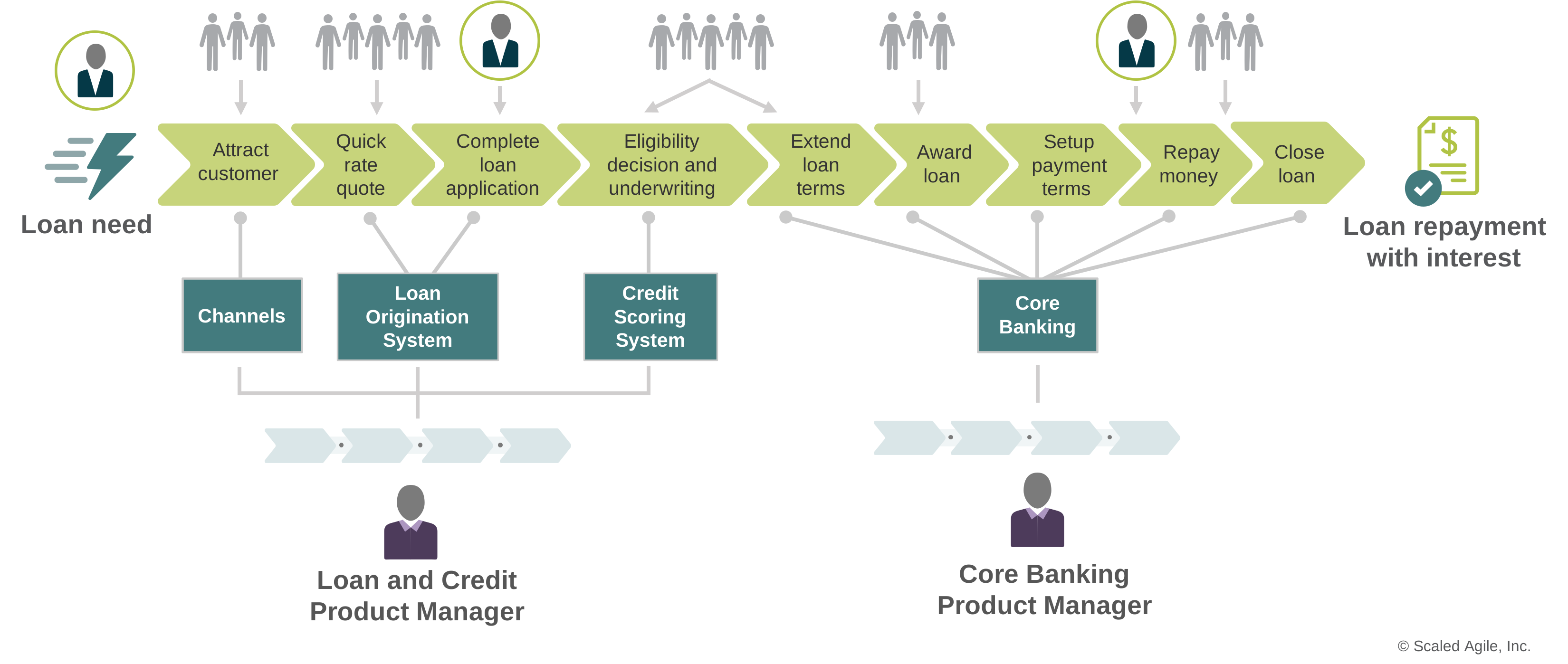
- External customers are outside the enterprise. They purchase, license, or use solutions for their own benefit. Figure 3 depicts external customers that use solutions in the operational value stream to submit loan applications and repay loans. The relationship between the enterprise and external customers can take the form of business-to-business (B2B), business-to-consumer (B2C), or business-to-professional (B2P) interactions.
It is common for product managers throughout the organization to work together in developing a final solution that is composed of several integrated solutions (Figure 4).
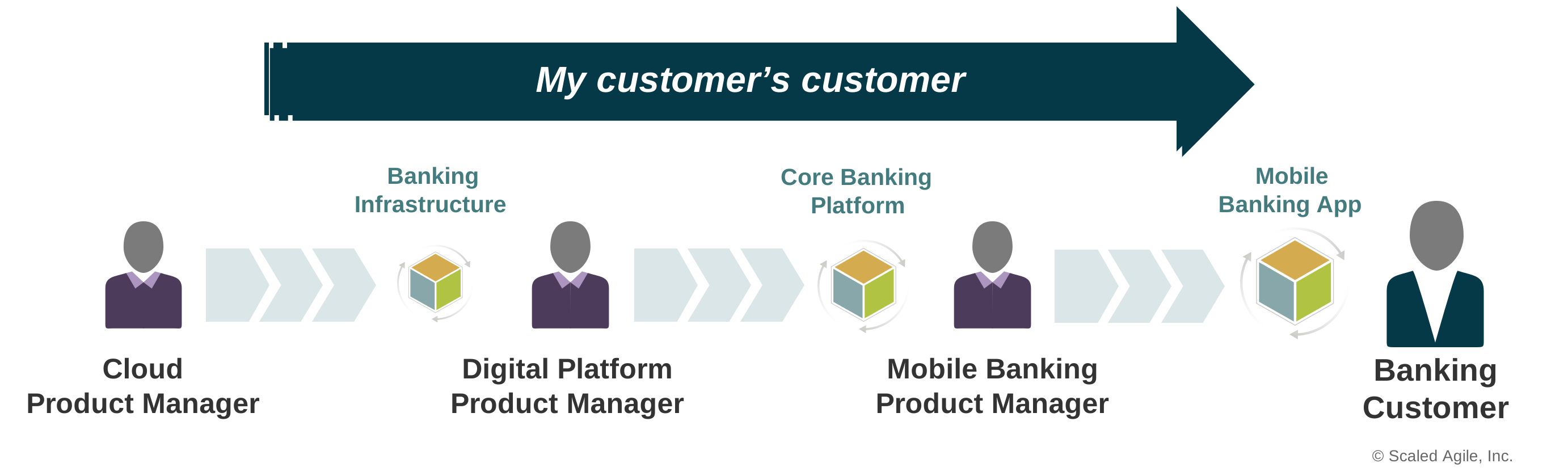
In this example, a mobile banking solution is delivered to external customers by a Mobile Banking Product Manager. The mobile banking app is built on a secure, compliant e-banking platform provided by a Digital Platform Product Manager. The core banking platform is built on scalable cloud infrastructure delivered by a Cloud Product Manager. Each oversees a solution that delivers a valuable product or service that is either consumed or further enhanced by the immediate customer. This scenario is especially common in the development of Large Solutions.
Learn More
[1] Fadell, Tony. Build: An Unorthodox Guide to Making Things Worth Making. Harper Business, 2022.
Last update: 4 July 2023