
People at work are thirsting for context, yearning to know that what they do contributes to a larger whole.
—Daniel Pink, Drive [1]
Solution Vision
The Solution Vision represents the future state of the solution under development. It serves as a reflection of customer and stakeholder needs and the proposed product or service to meet those needs.
In today’s dynamic and ever-evolving business environment, individuals seek purpose and the knowledge that their contributions align with a larger objective. Addressing this fundamental human need for purpose is essential in achieving successful Agile delivery. This article explores the significance of the solution vision and its critical role in driving energy, clarity, and alignment across all levels of the organization.
Details
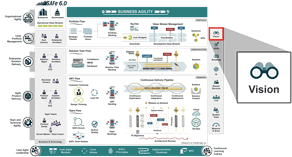
On the SAFe Big Picture, solution vision resides on the spanning palette. This reflects that a compelling solution vision guides and inspires individuals and teams throughout the organization, regardless of the SAFe configuration. The solution vision paints a vivid picture of the future, capturing the imagination and engagement of people while providing clear boundaries and context for the solution being built. It enables individuals to see that change is coming and envision themselves, customers, and stakeholders in that future. This clarity fosters a bias for action, facilitates trade-offs, and leads to prompt decisions rooted in a shared understanding of desired outcomes. Consequently, it empowers people and teams to operate in unison while preserving their ability to execute autonomously.
Lack of a well-crafted, well-communicated solution vision can result in misalignment, delays, friction, waste, defects, and reduced engagement. Ultimately, this hampers the organization’s ability to deliver value for itself and its customers. Investing in crafting and conveying a compelling solution vision is crucial to avoid these detrimental outcomes.
Expressing Solution Vision in SAFe
In SAFe, articulation of the solution vision balances inspiration and practicality, providing clear rationale and motivation, as well as a well-defined path forward.
The solution vision is a beacon of inspiration for the entire organization, providing a true north. The workforce’s passion has emerged as a critical differentiating factor in today’s highly competitive environment. Companies with purpose and engagement outperform those that lack these qualities. A motivating vision provides an environment where agility can thrive. To move people, the solution vision must possess two critical characteristics:
- Aspirational, yet realistic and achievable – The solution vision must be compelling and futuristic while remaining practical enough to be accomplished within a meaningful timeframe.
- Motivational – The solution vision must align with the Portfolio’s Strategic Themes and inspire the Agile Release Trains (ARTs) and teams.
An exceptional solution vision aligned with the characteristics above serves as a catalyst, igniting the workforce’s dedication and creativity to embrace and pursue this compelling picture of the future. When the organization collaboratively works to bring this vision to life, remarkable outcomes are attained.
Effectively conveying the solution vision requires selecting a format that suits the context and the audience. Different stakeholders may need different modes of communication. Employing imaginative approaches such as a postcard from the future, a video, a press release, or an infographic vividly portrays the future-state solution from the customer’s point of view.
Building Practical Alignment with Solution Vision
More than inspiration is needed to translate the solution vision into action. Practical guidance provides a clear path forward. For teams and ARTs to effectively act upon the solution vision, they must understand what they are building, who will benefit from it, and how it will address the customer’s pain points.
To be credible, the solution vision must describe a solution that possesses the following fundamental attributes:
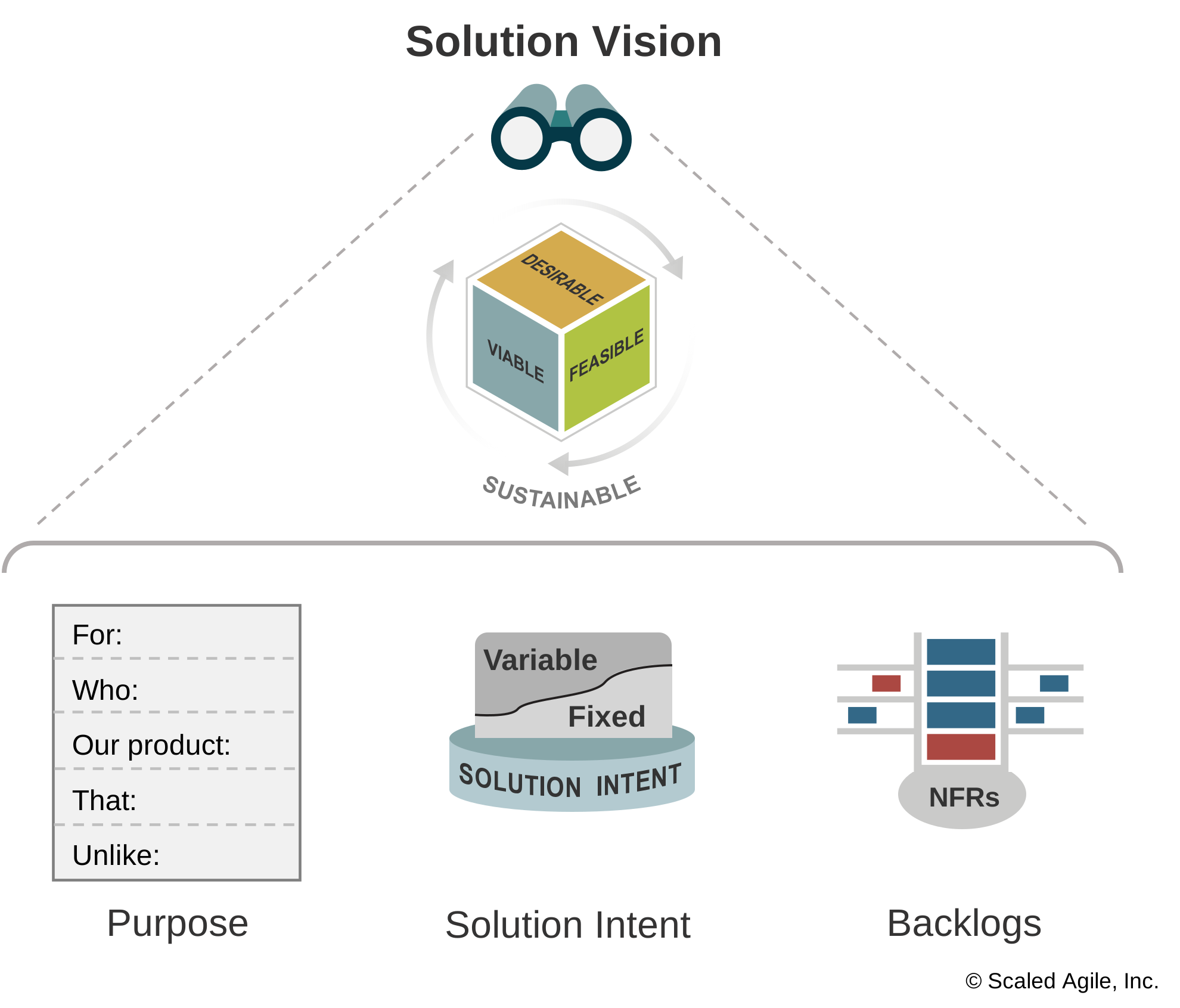
- Desirable – Do customers and users want the solution?
- Viable – Is how we build and offer the solution creating more value than cost?
- Feasible – Can we deliver the right solution through a combination of build, buy, acquire, or partner endeavors?
- Sustainable – Are we proactively managing the solution to account for its expected product-market lifecycle?
During development, solution goals, metrics, and the Design Thinking process will refine the understanding of the solution in accordance with these four attributes. This iterative approach provides context to create a more effective solution and business model. The solution vision must evolve as organizations learn more about customers and their needs.
The diagram below shows that the solution vision is brought to life in SAFe through three primary elements: solution purpose, Solution Intent, and backlogs.
Purpose
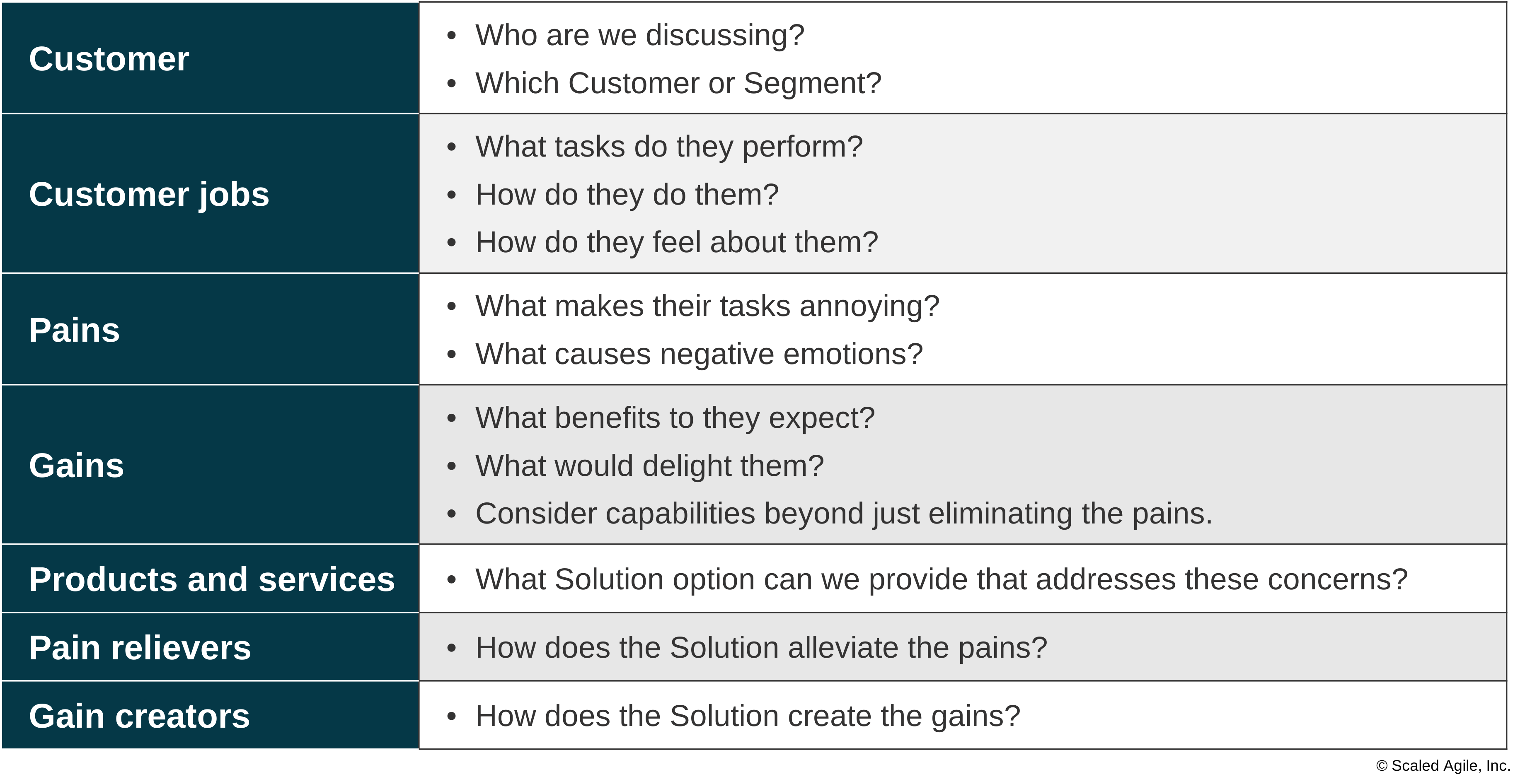
The first element is solution purpose, which addresses the ‘why’ of the solution. This requires careful analysis of customers and their needs—the questions in Figure 2 help establish the purpose.
Once the purpose is understood, the product must be ‘positioned’ and described so that customers can understand what it is and what it does for them. In Crossing the Chasm, [2] Geoffrey Moore explains the importance of ‘product positioning’ as a “way to create and occupy a space inside the target customers’ heads.” He also notes that customers won’t allow you to consume much space in their heads; therefore, creating a positioning statement requires extreme clarity and brevity. In doing so, it is a powerful focusing technique to help those building the solution crystallize the critical purpose element of the solution vision. As a form of shorthand or ‘elevator statement,’ Moore offers a simple template to capture these aspects:
![Figure 3. Product Positioning Statement (PPS) template [3]](/wp-content/uploads/2023/09/Solution_Vision_F03.svg)
- For – A customer-centric approach starts with sharply defining who the customer is for the product. This should be as focused as possible, assuring that the solution will meet the needs of a specific, primary, targeted customer type or segment. These customers will then inform the personas that are central to design thinking.
- Who – This prompt answers why the identified customer might be interested in a new solution. What is the problem they are facing with the current alternative? What is unique about their situation? What pain are they experiencing now?
- Our Product – “Potential customers cannot buy what they cannot name, nor can they seek out the product unless they know what category to look under.” [2] To have any meaningful discussion—internally and externally—the product must have a working name, a product category, and a description people can relate to when discussing the product.
- That – This portion of the statement describes in simple terms what the product will do for that customer and how it addresses the identified pain.
- Unlike – This section identifies the whole product (see Agile Product Delivery) features that differentiate the product from the current market alternative. It is essential to focus on differentiating from no more than one or two primary competitive alternatives.
Here’s a tight and pithy PPS taken directly from the book:
![Figure 4. Example Product Positioning Statement [3]](/wp-content/uploads/2023/09/Solution_Vision_F04.svg)
Solution Intent
Solution intent plays a crucial role in realizing the solution vision, codifying the current and future state of the solution and the knowledge required to build and evolve it effectively. The solution intent translates the aspirational vision into tangible requirements, specifications, and designs that Agile teams and ARTs can use to guide implementation. It applies to solutions of all scales, serving as a centralized knowledge capture mechanism for all individuals involved in the solution’s development. The format of solution intent can vary, ranging from a whiteboard to a comprehensive technical repository, and possesses the characteristics depicted in Figure 5.
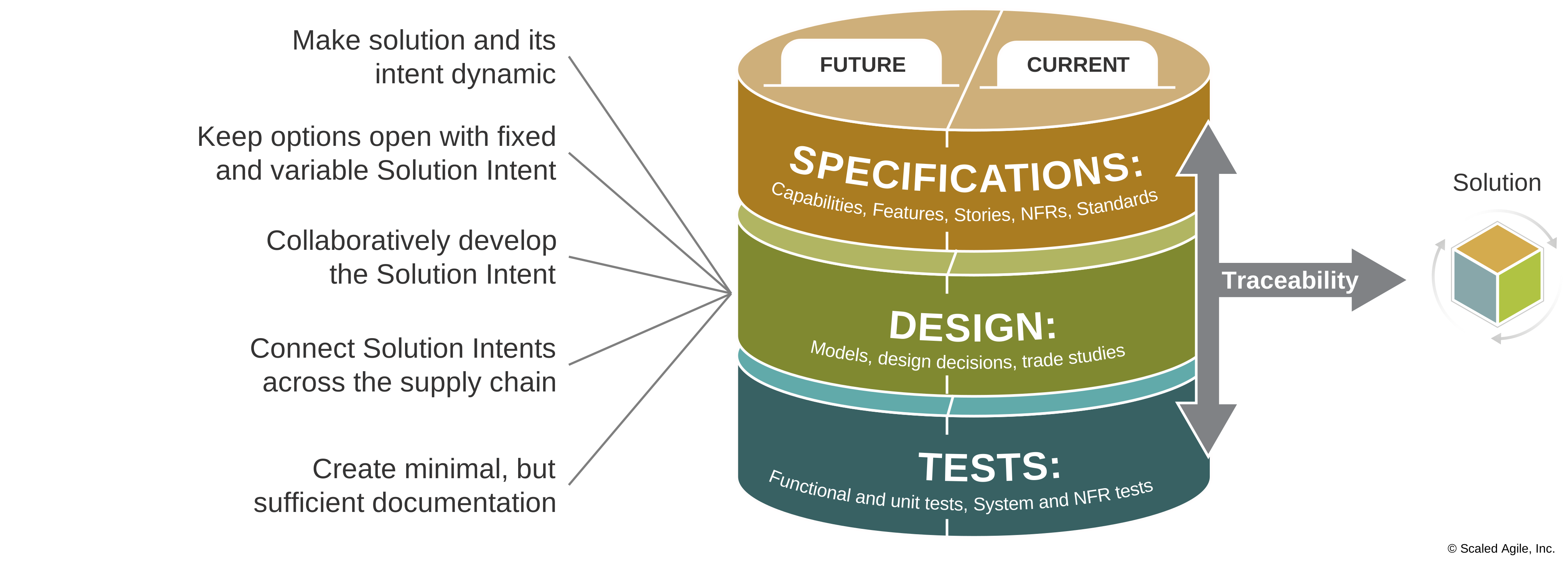
Solution intent ensures that a solution aligns with the intended needs of the target audience, which often includes adherence to compliance requirements. Teams leverage solution intent to explicitly capture and acknowledge these requirements rather than relying on assumptions or informal discussions. Solution intent is a vehicle for managing these and other requirements, specifications, traceability, and implementation detail, where that detail is required to realize the solution vision.
Solution intent is not exclusive to large systems like aircraft and MRI machines. Even when building systems of smaller scope, such as websites and mobile apps, there are usually design considerations that must be made explicit. For example, strict requirements related to cybersecurity, data privacy, interoperability, event logging, system performance, corporate branding, and so on may be critical to realizing the solution vision.
Backlogs
Backlogs are the actionable expression of the solution vision. The vision and the solution intent inform the work to be done to deliver the desired outcomes. This work appears as a dynamic list in the various backlogs, including Team Backlogs, ART Backlogs, and Solution Train Backlogs. These backlogs are decentralized and evolve as more information is learned and customer needs become more apparent. Backlogs are developed through close collaboration among stakeholders, including customers, Business Owners, System Architects, Solution Architects, Release Train Engineers, Solution Train Engineers, and the teams themselves.
Product Owners, Product Managers, and Solution Managers help their respective teams and ARTs maintain alignment between their backlogs and the solution vision. They continuously refine and prioritize the backlogs, ensuring the most valuable items are ready for implementation. Teams and ARTs work on the priority Stories, Features, and Capabilities in their backlog to implement the functionality incrementally, delivering a continuous flow of value in pursuit of the solution vision.
Achieving a Shared Solution Vision
Everyone in the value stream must do their part to achieve a shared solution vision. Leaders and team members must consistently align with the guiding solution vision and remain undeterred by inevitable distractions.
Leaders bear the responsibility of effectively communicating the solution vision. Communication is not a one-time endeavor but an ongoing and constant activity. Clarity is achieved through extensive communication, utilizing formal occasions such as PI Planning to disseminate the solution vision. While these formal opportunities for product leadership to share the product strategy, vision and roadmap are valuable, more is needed to keep the solution vision at the forefront of everyone’s minds. In his book The Advantage, Patrick Lencioni highlights the importance of leveraging various communication channels, including town halls, staff meetings, newsletters, and one-on-one conversations, to reinforce key messages. [3] By continually reiterating the solution vision, leaders establish the necessary clarity for its realization. Occasional misalignment and drift are common, and leaders must actively listen for signs of misalignment and promptly address them.
Equally, achieving a shared solution vision relies on the commitment and engagement of the workforce. ARTs and teams must wholeheartedly embrace the vision, channeling their passion and dedication to bring the solution to life. This necessitates the courage and commitment to engage with the solution vision —the true north—within the context of the ART and the team. SAFe events like PI Planning and System Demos provide opportunities to connect the solution vision with execution. Additionally, even less formal interactions, such as team syncs and backlog discussions, approached with curiosity and a hypothesis-driven mindset, are rooted in the solution vision.
A clear solution vision captures the hearts of people, providing them with the purpose and motivation to drive toward the envisioned future state. It also offers a clear rationale and a forward path, as outlined in the solution purpose, solution intent, and backlogs. Equipped with this information, teams, ARTs, and leaders have the necessary guidance to deliver desirable, viable, feasible, and sustainable solutions. These solutions, in turn, generate continuous value for the enterprise and its customers.
Learn More
[1] Pink, Daniel H. Drive: The Surprising Truth About What Motivates Us. Riverhead Books, 2011. [2] Moore, Geoffrey A. Crossing the Chasm: Marketing and Selling Disruptive Products to Mainstream Customers. HarperCollins, 2014. [3] Lencioni, Patrick. The Advantage: Why Organizational Health Trumps Everything Else in Business. Jossey-Bass, 2012.Last Update: 7 September 2023